
The flood is doubling
48,185 CVEs were published in 2025 — a record. 2026 is tracking to 66,000, around 180 a day. We already produced more in the first half of this year than in any full year before 2024.
And it is about to get worse. AI is now writing code that ships the same day and finding bugs at machine speed — on both sides. The curve you see below is the conservative read.
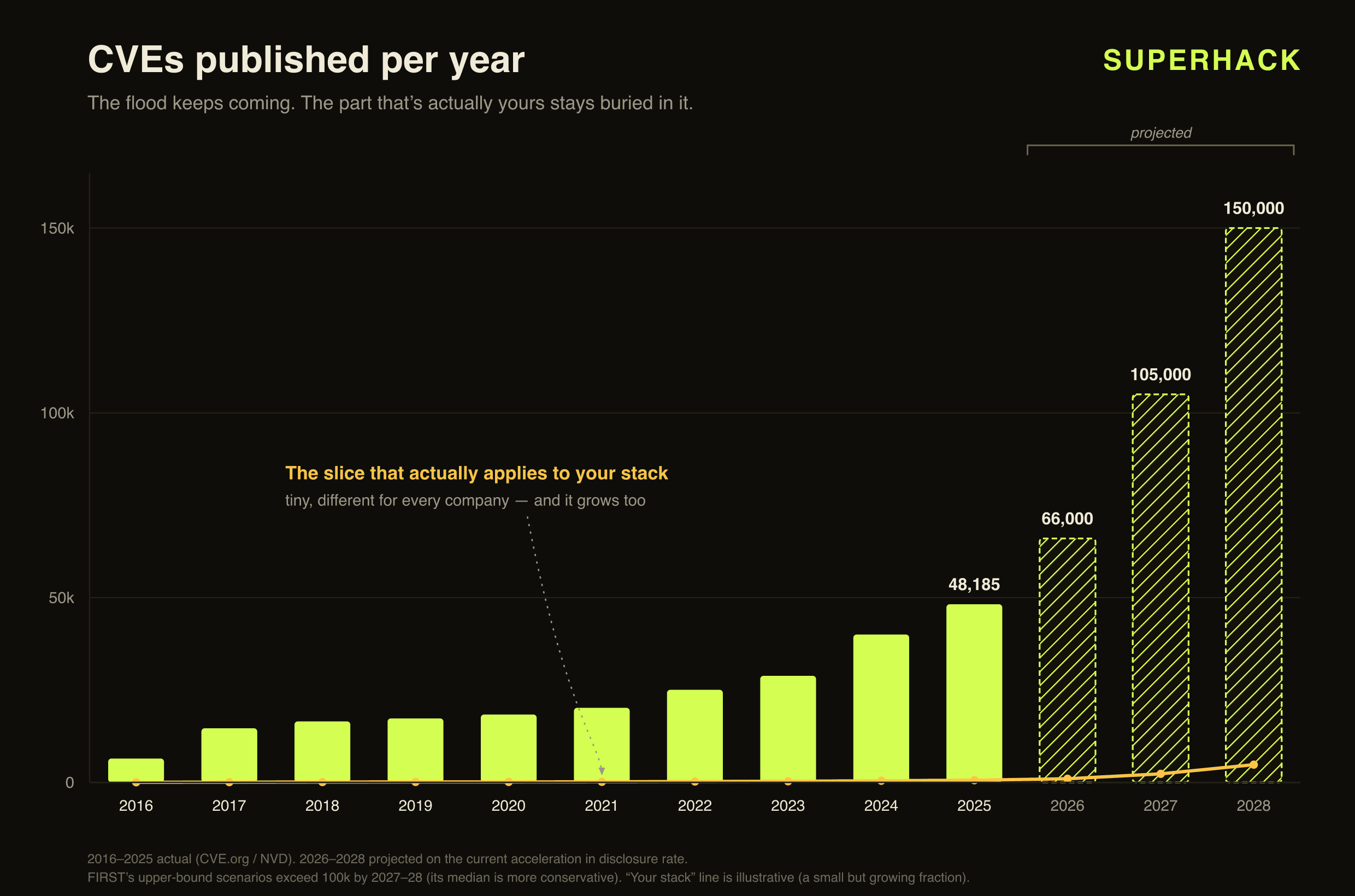
The system that is supposed to make sense of this can't keep up either. Only about a quarter of 2025's CVEs were fully analyzed and enriched on time; the rest sat in a backlog for months. By the time a CVE is neatly categorized, it has already been public — and, if it mattered, already used.
Volume was never the problem
Here is the part everyone skips. You are not supposed to patch all 66,000. Almost none of them touch your stack.
Say only 1% of them actually apply to you. That is already around 600 a year you have to reason about. The percentage barely moves — the raw number explodes, because 1% of 66,000 is one thing and 1% of 150,000 is another. Same slice, a far bigger pile every year.
And which slice is yours depends entirely on you. The same CVE is a five-alarm fire for one company and completely irrelevant for the one next door — it comes down to your exact software, your versions, your config, whether the vulnerable path is even reachable in the way you deployed it. A severity score can't tell you that. It measures a vulnerability in the abstract, not your system in production.
The hard part was never patching. It's sitting there trying to work out what genuinely applies to you — or whether it's just another CVE out there that has nothing to do with your systems.
Why you can't do this by hand
180 new CVEs land every day. The disclosure data arrives months late. Meanwhile the average enterprise still has nearly half of its known vulnerabilities unpatched a year later, and the average time to fix one has crept past 250 days.
So the honest answer to “which of today's CVEs matter to us?” is usually a shrug, a spreadsheet, and a hope that the annual pentest — run once, with a several-month delay — happened to cover it. It didn't. Nobody has the hours to map a daily flood onto their real inventory, decide what is actually reachable, and then prove it. Not by hand.
So we built the CVE checkup routine
It runs on a schedule — daily or weekly, your call — and does the boring, impossible-by-hand work for you, per asset group:
- It already knows your stack. Superhack maps your software from recon — the frameworks, packages, OS daemons, and services actually running on your surface. The checkup correlates every newly published CVE against that real inventory, not a generic list.
- Only genuinely new ones. Novelty comes from diffing against what it has already seen for you — never from a feed's publish date, which is really an import date and lies. You get the delta, not the same 40,000 rows re-notified every day.
- It throws out what can't hit you. For each match it judges version-fit and exposure: patched already, unreachable in your config, or not really you — dismissed, with a reason. What survives is the short list that could actually matter.
- Then it proves the rest. This is the part a scanner never does. The worth-testing CVEs go through the same exploit engine that runs our scans, against your live target. You get CONFIRMED findings with evidence, the false positives filtered out because we tested them, and the ones we couldn't reach flagged honestly.
- And it tells you where you already are. When something real lands, you get pinged — in Slack — with the CVE, the asset, and the proof. Not a 4,000-row dashboard. The handful that are yours, today.
It doesn't alert you that a CVE exists. It tells you which ones are yours — and proves the real ones.
That is the whole point of Superhack: we don't hand you a longer list. We hand you the short one that's all real.
Point it at your stack
The flood isn't slowing down, and it isn't getting quieter with AI in the loop. But the question underneath it is answerable: which of these are actually mine, and which matter today.
We'll set the CVE checkup up on your org for a test, walk you through what it finds, and prove every one of them — completely free.